The Creation Spirituality Lineage Calling All Social and Environmental Activists, Mystic Explorers, Justice Makers, Cosmic Thinkers, Earth Keepers Daily Meditations with Matthew Fox |
Watch for Matthew Fox's
video meditation — now appearing every Monday! Are you missing half the DM? If you're not seeing Queries for Contemplation, Recommended Reading,
Upcoming Events, Creation Spirituality Conversations, and more, look at the very bottom of the email for "..." Click the ellipsis, and enjoy! |
Prayer and the Body, Part IBy Gianluigi Gugliermetto 8/27/2025 |
Western Christianity is often considered the less embodied of all religious expressions of humankind. And for good reasons, starting with Saint Augustine reducing religion to a discourse between God and the soul. A quite disembodied soul, alas. |
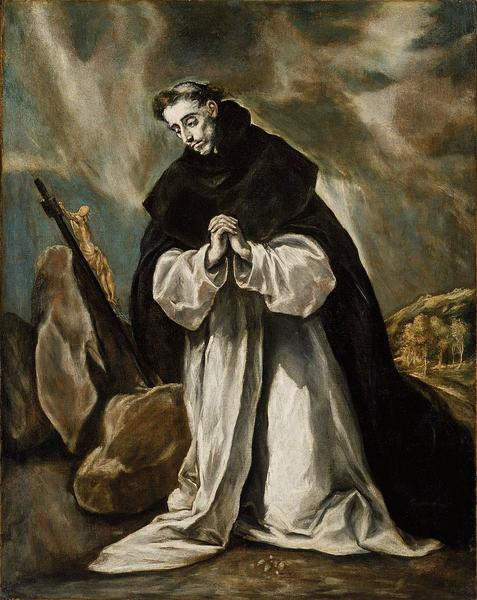
Many premodern examples of bodily prayer, however, are often excluded from consideration. One such example is represented by Saint Dominic (1170-1221), the founder of the Order of Preachers — popularly called “Dominicans.” Since the 16th century, Dominic has been wrongly associated
with the Inquisition. Even though it is true that, after 1230, several Dominicans ran the French version of that hellish thing, there are credible sources asserting that, at least in one case, |
“St. Dominic in Prayer.” Painting by El Greco. Wikipedia. |
Dominic saved a woman accused of heresy from being lynched by the crowd. |
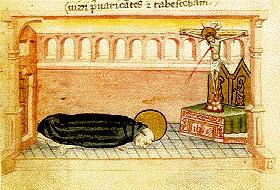
Dominic is portrayed by the sources as a constant pray-er. His “nine ways of prayer” are presented in one 13th-century booklet collecting the testimonies of eye witnesses. And all such nine ways are concerned with the body. Dominic bowed profoundly before the time of prayer, and before the image of the crucified Jesus, and at each mention of the Holy Trinity, in order to learn humility not with his mind, but with his body. |
“St. Dominic Prostrating Himself.” Image from the manuscript of De Modo Orandi in the Vatican Library. Wikimedia Commons. | Often he prostrated himself completely on the ground, where he would moan and growl, repeating mantras such as: “My soul lays in the dust” — which makes me think of that portion of the Cosmic Mass when people are invited to lay down, feel the pain of the world, and express their |
grief accordingly. The sources, however, also report Dominic partially prostrated not in grief, but in adoration of the majesty of God, and suggesting the younger friars to learn the same. This is very much like what
good Muslims do seven times a day. Dominic used to genuflect and stand up repeatedly, hundreds of times in a row, while repeating sentences from the Psalms such as I cry to you, O God, don’t be silent! More often than not, however, during such holy gymnastics, he stopped abruptly and entered into
ecstasy, transfigured by joy. Then, his copious tears would quench his deep thirst for divine love. Often he prayed standing motionless for long stretches of time, sweetly repeating to himself words from Scripture, but also opening his arms in a welcoming gesture or putting one hand to his ear, perhaps listening to an angel
speaking to him. He did also sit, read, and meditate on the Scripture in utter silence, as you would expect a good friar to do. But, at times, he stood up and raised his hands as high as he could, and then you knew that he was asking something from God. He would not lower his arms until he got his answer. |
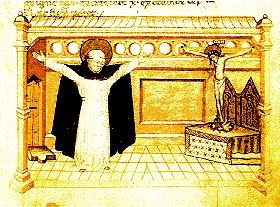
More rarely, Dominic prayed stretching his arms in the form of a cross. His biographers report that he would be seen in such a position only when some wonder was going to happen. He prayed even when travelling on foot. After such walking prayers, he became very excited and his words would burn
like fire. |
Saint Dominic with arms outstretched as if on a cross. Image from the manuscript of De Modo Orandi in the Vatican Library. Wikimedia Commons. |
The same booklet also reports one form of prayer in which Dominic inflicted pain on himself by means of a whip. This “form of prayer” however, is very briefly described — one sentence only — and I suspect it might have been introduced to justify a later Dominican practice. I was pleased and stimulated when I found out that Saint Dominic prayed constantly with his body and that much of his prayer — though imbued with Scriptural verses — was intimate, spontaneous, rich, and even somewhat unhinged, that is, unregulated and presenting traits that today would not be considered acceptable. Do people today growl, cry, weep, exult, burn, or listen to angels when they pray? And are we to judge and condemn our premodern examples of pray-ers, or there is something we can learn from them? |
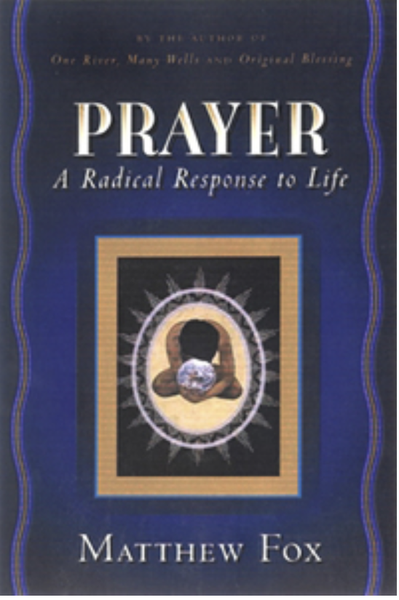
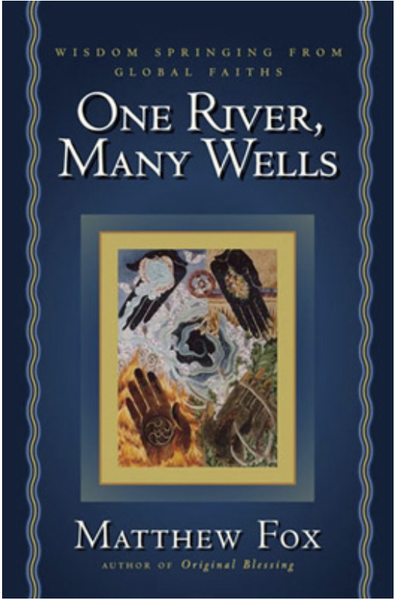
See Matthew Fox, Prayer: A Radical Response to Life See also Fox: One River, Many Wells: Wisdom Springing from Global
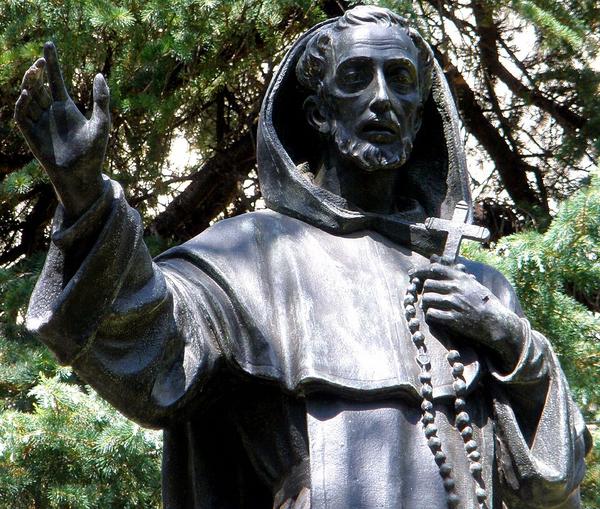
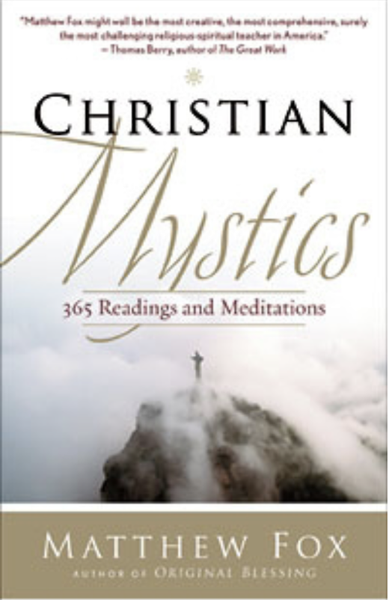
Faiths And Fox, Christian Mystics: 365 Readings & Meditations Banner image: Statue of Saint Dominic. Palencia, Spain. Wikimedia Commons. |
Mystic-Warriors at the Roof of the World In Monday's DM, we shared the story of Marianne Grosspietsch and the Shanti Leprosy Aid organization of Nepal: faced with the loss of food from USAID, her community is planting thousands of fruit trees to nourish the hungry in the region while mitigating the effects of climate change.
We invite you to consider supporting this work HERE (US$) or HERE (€ and other currencies). |
|
Queries for Contemplation Do you involve your body in prayer?
How? |
Responses are welcomed. To add
your comment, or read other comments and enter into dialogue, please click HERE to go to our website and scroll down to the Comments field. |
Prayer: A Radical Response to Life How do prayer and mysticism relate to the struggle for social and ecological justice? Fox defines prayer as a radical
response to life that includes our “Yes” to life (mysticism) and our “No” to forces that combat life (prophecy). How do we define adult prayer? And how—if at all—do prayer and mysticism relate to the struggle for social and ecological justice? One of Matthew Fox’s earliest books, originally published under the title On Becoming a Musical, Mystical Bear: Spirituality American Style, Prayer introduces a mystical/prophetic spirituality and a mature conception of how to
pray. Called a “classic” when it first appeared, it lays out the difference between the creation spirituality tradition and the fall/redemption tradition that has so dominated Western theology since Augustine. A practical and theoretical book, it lays the groundwork for Fox’s later works. “One of the finest books I have read on contemporary spirituality.” – Rabbi Sholom A. Singer |
|
One River, Many Wells: Wisdom Springing from Global Faiths
Matthew Fox calls on all the world traditions for their wisdom and their inspiration in a work that is far more
than a list of theological position papers but a new way to pray—to meditate in a global spiritual context on the wisdom all our traditions share. Fox chooses 18 themes that are foundational to any spirituality and demonstrates how all the world spiritual traditions offer wisdom about each.“Reading One River, Many Wells is like entering the rich silence of a masterfully directed retreat. As you read this text, you reflect, you pray, you embrace Divinity. Truly no words can fully
express my respect and awe for this magnificent contribution to contemporary spirituality.” –Caroline Myss, author of Anatomy of the Spirit |
|
Christian Mystics: 365 Readings & Meditations
As Matthew Fox notes, when an aging Albert Einstein was asked if he had any regrets, he replied, “I wish I had read more of the mystics
earlier in my life.” The 365 writings in Christian Mystics represent a wide-ranging sampling of these readings for modern-day seekers of all faiths — or no faith. The visionaries quoted range from Julian of Norwich to Martin Luther King, Jr., from Thomas Merton to Dorothee Soelle and Thomas Berry.
“Our world is in crisis, and we need road maps that can ground us in wisdom, inspire us to action, and help us
gather our talents in service of compassion and justice. This revolutionary book does just that. Matthew Fox takes some of the most profound spiritual teachings of the West and translates them into practical daily mediations. Study and practice these teachings. Take what’s in this book and teach it to the youth because the new generation cannot afford to suffer the spirit and ethical illiteracy of the past.” — Adam Bucko, spiritual activist and co-founder of the
Reciprocity Foundation for Homeless Youth. |
|
UPCOMING EVENTS See Matthew Fox's full calendar HERE |
Join Matthew Fox in a new 6-month program of mystical wisdom for a new world.
In this 6-month immersion program with Matthew, you’ll explore what it means to be a modern mystic and prophet, integrating this sacred knowledge into your life through the authentic teachings of Jesus and other wisdom keepers. This journey births what Matthew calls Christianity 2.0 — based not on dogma, but on a spirituality that recovers the sacred sense of original goodness. By Application only - apply HERERegister for a free information session HERE |
|
|
|
|
|
MONTHLY: Join Matthew Fox and Skylar Wilson of the Order of the Sacred Earth in a free virtual meeting for connection and networking with other mystic warriors. Last Tuesday of every month, 4:00-5:00pm PT.
Join Zoom Meeting HERE, Meeting ID: 886 6530 2478 Learn more at www.orderofthesacredearth.org |
Creation Spirituality Conversations |
Matthew Fox and Fr. Bede Griffiths each lecture for approximately 30 minutes followed by 30 minutes of dialogue. 91 minutes. 1990. You will receive a secure link to the file to download. |
|
Inspired by this post? Share your insights on BlueSky, Instagram, Universeodon, or Facebook using the hashtag #RevDrMatthewFox and tag Matt with @RevDrMatthewFox FOLLOW MATTHEW FOX: |
|
|
|